Bring clarity, capability, and
consistency to your workforce.

Virtual Reality's ability to simulate risky and dangerous situations is among one of its most lauded and leveraged advantages, especially when it comes to training. Surgeons regularly train in VR so they don't operate on real, living human beings. Pilots use flight simulators to eliminate the risk of making mistakes in a flying, moving aircraft.

In partnership with Site Safe and the Ministry of Social Development (MSD), construction workers in New Zealand and all over the world can undergo health and safety training in Virtual Reality - plus get the certifications they need to validate and demonstrate their competency!
There are three main reasons why industry looked to Virtual Reality technology as one of its many efforts to improve health and safety standards all over the country: (1) it eliminates training risks, (2) VR delivers consistent training content and high learning outcomes, and (3) it provides accurate and reliable verification of competency.
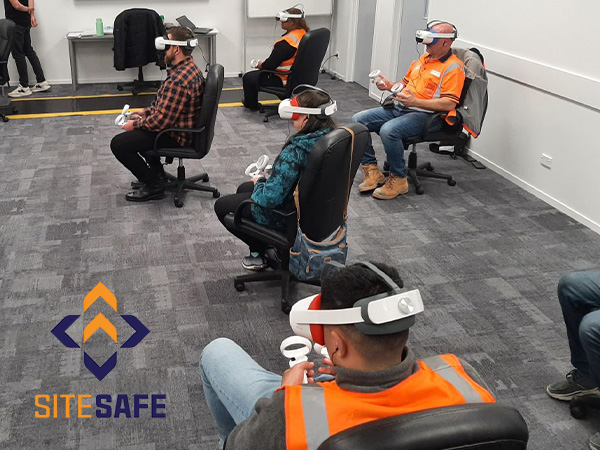
Eliminates training risks. Similar to the medical and aviary industries, Virtual Reality creates safe, simulated environments for providing health and safety training in construction. VR eliminates the need for organizations to take untrained staff onto the work site and prevents staff from using potentially dangerous equipment before they receive proper training.
Consistent training and high learning outcomes. Using VR as a training modality ensures consistency in training content. It minimizes and/or eliminates training bias as well as external distractions common in traditional or even e-learning spaces, keeping learners engaged and laser focused on the content to ensure high learning outcomes.
Verifies competency. With the SkillsVR training platform, organisations can rest assured that learning outcomes are automatically logged through Learning Records. This automated competency log powers our ability to accurately verify competency and provide skills certification for the Site Safe Foundation Passport.
The SkillsVR Site Safe Foundation Passport module takes learners from both civil and building industries through basic health and safety concepts. This includes:
The importance of health and safety, correct personal protective equipment (PPE), hazard identification and control (i.e. preparing the site to be safe for work), and mental health in the workplace (including stress, fatigue, and bullying).
In the last 3 years, New Zealand recorded 31 work-related fatalities in the construction industry and over 1,800 cases of injury, illness, and serious harm in the same time period. In 2020, Accident Compensation Corporation (ACC), spent $153 million to support the 48,650 injured construction workers that year, and construction sites became the deadliest workplaces after agriculture, forestry, and fishing.
In an industry that relies heavily on the human body's ability to work embedded in a "She'll be right" Kiwi culture, changing the way we view health and safety will be a huge shift - but one that's well worth the effort to ensure all workers can get home to their families safely.
At SkillsVR, we transform learning into an engaging and enjoyable experience. Our VR training solutions are cost-effective, easy to implement, and scalable to meet your needs. Backed by a team of world-leading experts in immersive learning, we're dedicated to ensuring exceptional training outcomes to elevate your organization’s potential. Join us in unlocking the future of training and achieving impactful results.